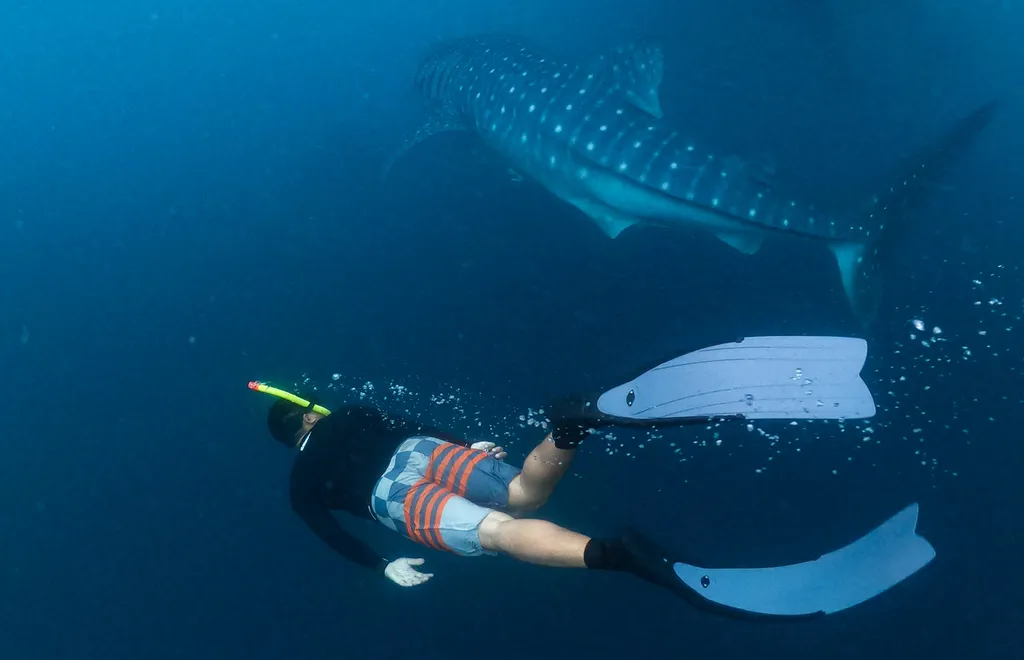
I still remember the first time I saw a whale shark. It was early morning in Saleh Bay, Sumbawa. The sea was flat, the light was soft, and our boat had gone quiet. Everyone knew something magical was about to happen.
Then it appeared—calm, immense, covered in constellations of spots that shimmered beneath the surface. The kind of moment you hold in your chest for a long time. But here’s what really stayed with me: the conversation I had later that day with one of the local guides. He told me that growing up, he didn’t know what whale sharks were. Just that they were big, came near the fishing platforms, and weren’t dangerous. He only learned their name—and how special they are—when tourists started coming.
That hit me.
It reminded me that tourism, when done thoughtfully, doesn’t just bring in money. It brings knowledge, awareness, and often, pride. Especially in places like Sumbawa, where majestic marine life like whale sharks has lived side by side with local communities for generations—but without always being understood.
More Than Sightseeing
Most people think of travel as an escape, a way to relax or explore. But tourism can be more than just sightseeing. In Saleh Bay, for example, the growing interest in the Sumbawa whale shark tour has opened the door to something deeper—education.
Not only for tourists, but for locals. Kids in nearby fishing villages now grow up hearing about the whale shark as something to be protected, not feared. Schools invite marine experts. Posters and community talks explain how these animals live, why they matter, and what role humans can play in their future.
That’s something tourism helped spark.
From Curious Tourist to Informed Advocate
One of the most powerful things I’ve seen is how a simple tour can shift someone’s mindset. When you meet a whale shark up close—when you watch it glide past, slow and silent—it’s hard not to be moved. But the experience goes deeper when your guide starts talking about how the sharks feed, how far they migrate, and what threats they face.
That’s the moment where something clicks.
I’ve seen visitors start out snapping photos for Instagram and end up asking how they can help protect these creatures. Some even support education programs, donate to research, or help spread awareness back home.
That’s the ripple effect of a good experience—it turns tourists into storytellers. Into advocates.
And that’s where businesses like Saleh Bay whale shark tour play a crucial role. They’re not just organizing trips. They’re connecting people—tourists and locals alike—to something bigger than themselves.
Local Knowledge Meets Scientific Insight
What’s unique about the whale shark story in Sumbawa is how traditional life and marine science are starting to meet. Fishermen here have observed the patterns of these animals for decades. They know when the sharks come, what they feed on, and how they behave around boats.
But now, thanks to the rise of sustainable tourism, that local wisdom is being woven together with scientific research. Marine biologists are collaborating with local communities. School programs are being supported by tourism groups. And young people in the area are starting to see marine biology not as something distant or foreign—but as a career path.
That’s the long-term gift of educational tourism. It doesn’t just explain the ocean—it opens doors.
Community Education Starts with Respect
One of the most important lessons I’ve learned from traveling is that education only works when it’s rooted in respect. When tourists arrive curious, humble, and open-minded, they leave room for two-way learning.
In Saleh Bay, many tours now begin with a briefing—not just on safety, but on local culture, marine etiquette, and how to be present without disturbing the whale sharks. Guests learn not to touch or chase, and to let the animals set the pace.
That kind of mindfulness trickles into other things too. Tourists ask more questions. They talk to their guides. They learn not just about the sharks, but about the people, the bay, the island.
It becomes an exchange, not a transaction.
And for the local community, seeing outsiders take the time to learn and respect their home helps build confidence. It says, what we have here matters. That kind of affirmation is powerful—especially in regions that are often overlooked on the global map.
Where Education and Experience Blend
There’s something beautiful about seeing a child point to a whale shark mural on their school wall, knowing that the animal it shows lives just offshore. There’s something even more powerful about seeing that child grow up, study marine science, and become a guide for future visitors.
That’s what’s starting to happen in places like Sumbawa. And it’s why the kind of tourism happening around whale sharks in Saleh Bay matters.
Every traveler who takes the time to listen, learn, and observe adds to the momentum. Every responsible tour operator who puts education at the center of their work builds something that lasts longer than a photo album.
Because eventually, the whalesharks will dive, the trip will end, and the sun will set behind the hills of Sumbawa. But the knowledge shared—that sticks around.
It lives in conversations. In classrooms. In community meetings. In the quiet pride of a fisherman’s voice when he tells his son, “That one there—that’s a whale shark. They’re our neighbors. And we protect them.”